
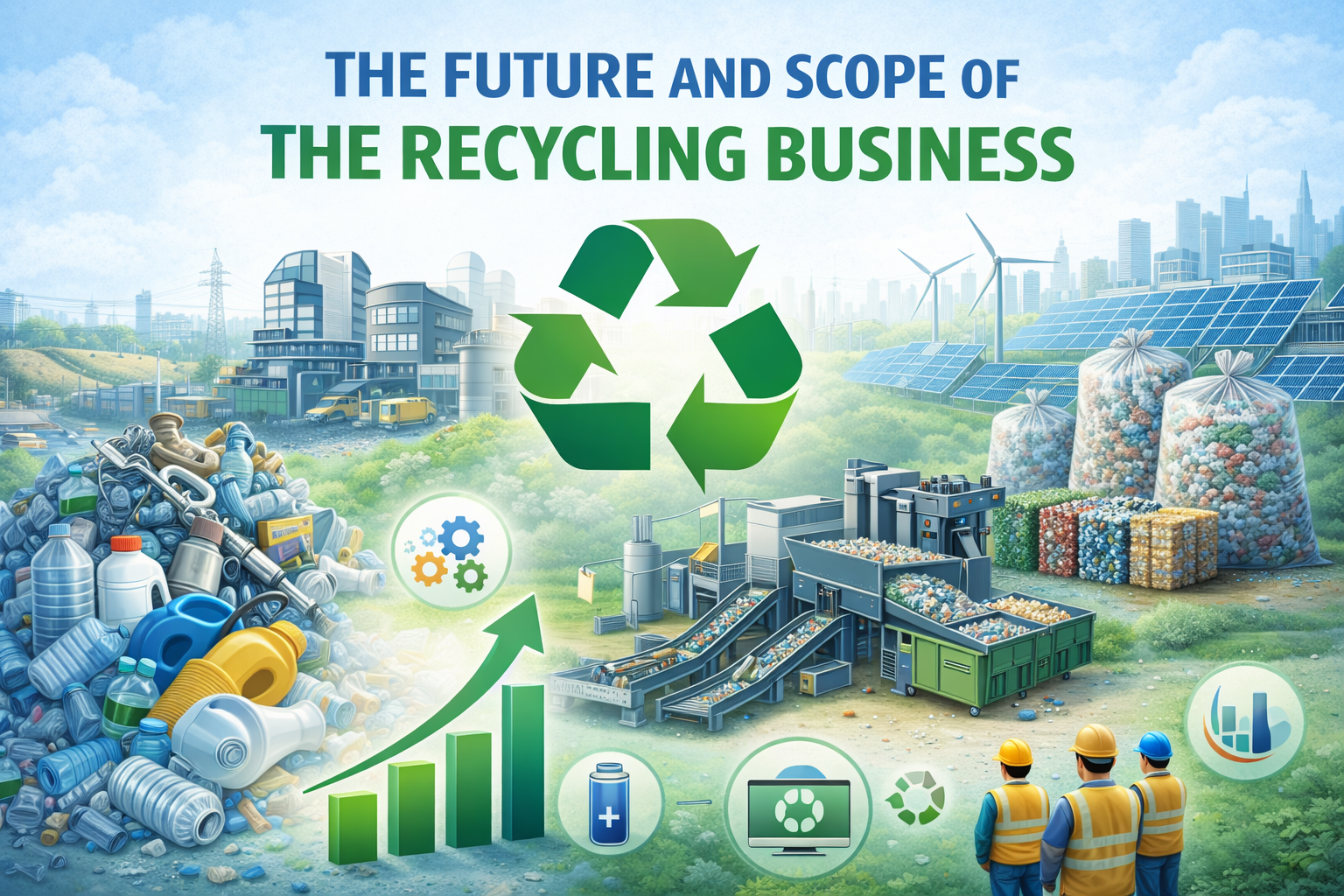
The Future and Scope of the Recycling Business
The recycling business is no longer just an environmental activity — it is becoming one of the most important and fast-growing industries in the world. With increasing waste generation, stricter government regulations, and rising demand for sustainable solutions, the future of the recycling business looks extremely strong and promising.
This blog explains the future trends, growth potential, and long-term scope of the recycling business in simple and easy-to-understand language.
Why the Recycling Business Has a Strong Future
Every year, the amount of waste generated by cities, industries, and households is increasing rapidly. Landfills are reaching their limits, and natural resources are becoming scarce. Because of this, recycling is no longer optional — it is essential.
Key reasons why recycling has a strong future:
- Rapid growth in plastic, e-waste, and industrial waste
- Limited availability of natural raw materials
- Rising environmental awareness
- Government policies supporting recycling
- Increasing demand for recycled materials
These factors ensure that recycling will remain a long-term and sustainable business opportunity.
Growing Demand for Recycled Materials
Industries such as packaging, construction, automotive, textiles, and electronics are increasingly using recycled raw materials instead of virgin materials.
This creates:
- Continuous demand for recycled plastic, metal, and paper
- Stable pricing for recycled output
- Long-term buyers for recycling plants
As more companies adopt sustainability goals, the demand for recycled materials will continue to rise.
Government Support and Regulations
Governments across the world are introducing:
- Strict waste management rules
- Extended Producer Responsibility (EPR) policies
- Bans on single-use plastics
- Incentives for recycling and waste processing
These regulations directly increase the need for organized recycling plants, making recycling a regulation-driven and future-proof business.
Technology Is Shaping the Future of Recycling
The future of recycling lies in automation, smart systems, and efficient machinery.
Upcoming trends include:
- Automated sorting and separation systems
- Energy-efficient shredding machines
- Data-driven plant operations
- Improved recovery rates and output quality
Modern recycling plants are becoming more productive, more profitable, and easier to operate.
Circular Economy: The Backbone of the Future
The world is shifting from a “use and throw” model to a circular economy, where waste is reused as a resource.
In a circular economy:
- Waste becomes raw material
- Recycling plants play a central role
- Industries depend on recycled inputs
- Environmental impact is reduced
Recycling businesses are at the heart of this system, making them essential for future economic growth.
Scope of the Recycling Business in the Coming Years
The scope of recycling is expanding into many areas, such as:
- Plastic recycling plants
- E-waste recycling facilities
- Battery and electronic waste processing
- Municipal solid waste recycling
- Industrial and hazardous waste recycling
Each segment offers huge growth potential and opportunities for specialization.
Employment and Business Opportunities
The recycling industry creates jobs at multiple levels:
- Plant operations
- Machine manufacturing and maintenance
- Logistics and waste collection
- Engineering and technical services
As recycling plants increase, they generate employment, entrepreneurship, and local economic development.
Long-Term Profitability and Sustainability
Unlike many businesses, recycling offers:
- Continuous raw material supply (waste never stops)
- Long-term demand
- Scalability and expansion options
- Positive environmental impact
This makes recycling a stable, recession-resistant, and socially responsible business.
Conclusion
The future of the recycling business is bright, sustainable, and full of opportunity. As waste generation increases and industries move toward sustainability, recycling plants will become a backbone of modern infrastructure.
With the right planning, technology, and execution, recycling is not just a business — it is an investment in the future of the planet and the economy.
Recycling today means building a cleaner, smarter, and more sustainable tomorrow.